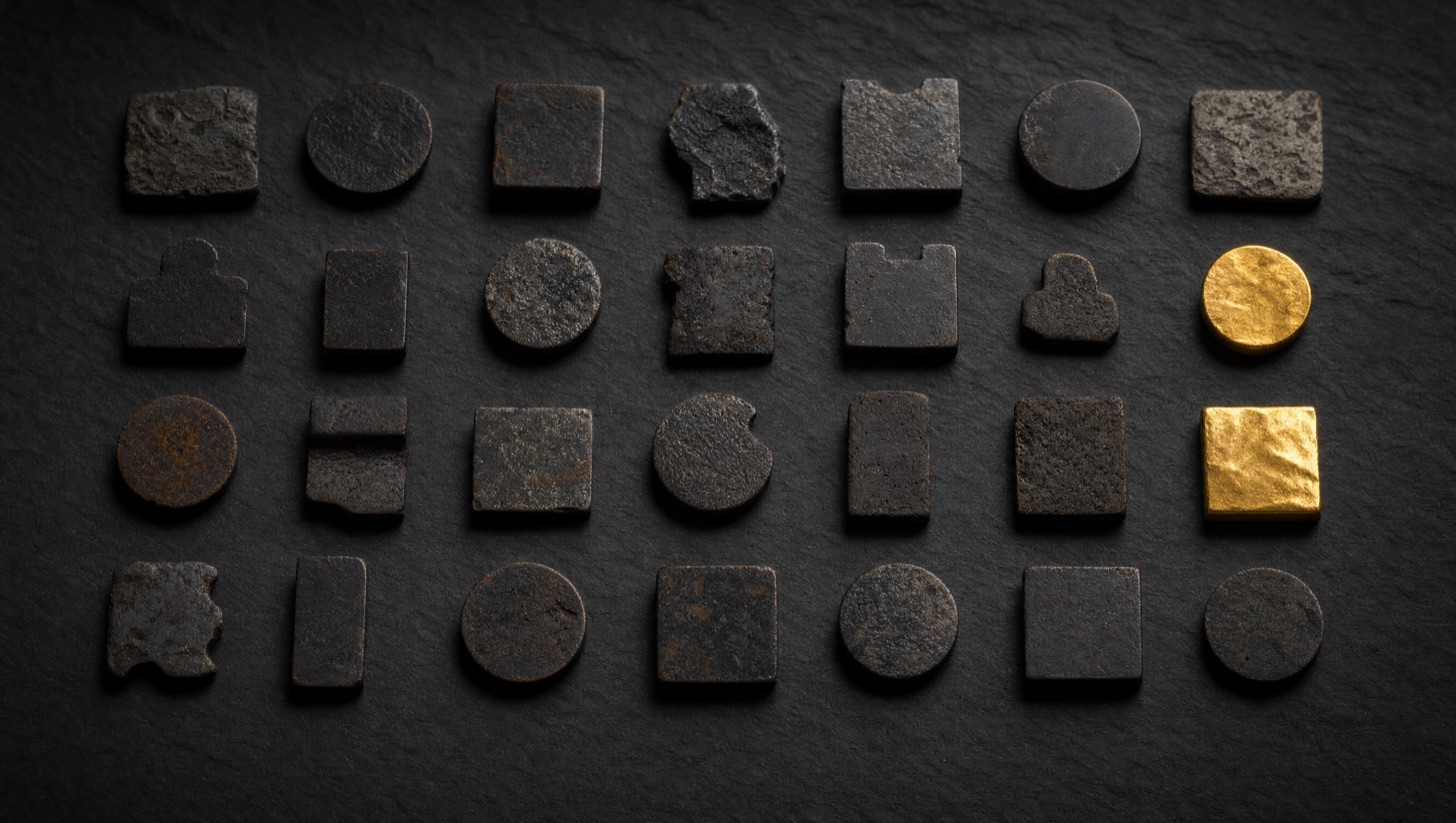
What did not survive
Each technique was coded exactly as its original source describes it, tested across decades of data, and then penalised statistically for how many variants were tried. Not one of these was left standing.
- ✕RSI overbought / oversold
- ✕MACD crossover
- ✕Candlestick patterns (hammer, harami)
- ✕Head and shoulders
- ✕ADX / DMI as a trend filter
- ✕Double stochastic
- ✕Moving-average bands and envelopes
- ✕Channel breakout (Donchian / turtles)
- ✕Statistical pairs
- ✕Minor calendar seasonalities
That list is, almost exactly, the catalogue every signal group sells. We are not saying it is impossible to trade them. We are saying that when we tested them with statistical honesty, the outcome was indistinguishable from chance.
The result that suits us least
On gold, forex and crypto: none survived
This is the market we trade, so it is the finding that binds us most. We tested the twenty textbook strategies on gold, the major currency pairs and the ten most liquid cryptocurrencies — on the daily chart and intraday too, down to fifteen-minute candles.
Not one survived the statistical correction. The only two that did withstand the full test work on US equities on the daily chart, and their edge is one of controlled risk — not of beating the market.
We are not publishing this because it suits us. We are publishing it because it is what we found, and because a group that only publishes what went well is not showing you its research: it is showing you its marketing.
How we tested it
Almost any strategy looks profitable if you test it badly. These are the defences we used, and they are the most important part of the whole exercise.
Rolling window
Every parameter is chosen using only data from before the period being measured. Nothing is ever optimised on the same stretch it is later judged on.
Rules frozen in advance
The selection criteria were written down and sealed with a cryptographic signature before a single result was seen.
Correction for attempts
Given enough tries, something always looks brilliant by pure luck. Every result is penalised according to how many variants were tested.
Sealed data
Two years of market history that no program and no person touched during the entire research, opened exactly once at the end.
Adversarial review
Independent reviewers whose job was to refute every finding. Several of our own mistakes were caught this way, and they are documented.
Reproducibility
Every test re-runs and produces exactly the same result, verified across a sample of more than thirteen thousand tests.
What you can do with this
The use of this research is not that we sell you something. It is that you now have concrete questions to put to anyone offering you a strategy — ourselves included.
- How much data was it tested on? A good result over a few months means nothing. Here we used up to twenty-three years per instrument.
- Did they correct for the number of attempts? If they tried a hundred variants and show you the best one, they are showing you luck, not an edge.
- Is there data they never touched? Without a portion sealed in advance, there is no way to know whether the result was fitted to the past.
- Do they also publish what failed? This page exists for that. A track record where everything works is the oldest red flag in the craft.
If you found this useful, the guide to spotting fake signal groups develops the same ideas from the consumer's side.